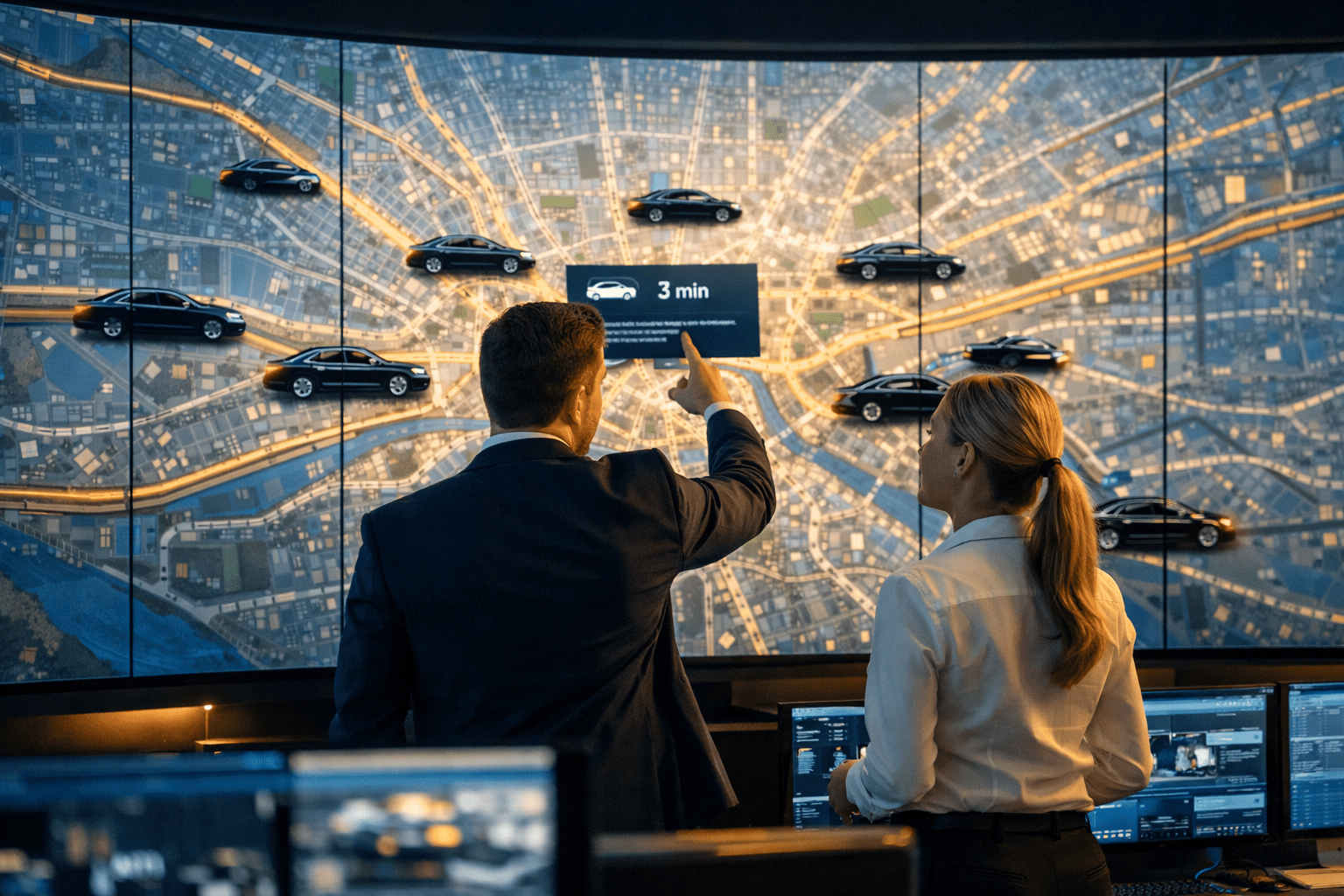

Real Time Driver Tracking: End the Guessing Game
Your chauffeurs are on the road. However, you cannot see them. Consequently, clients ask: “Where is my car?”
Drivers silence their radios. Arrival times become guesses. This lack of visibility erodes trust.
Implementing real time driver tracking eliminates this uncertainty. It transforms reactive chaos into proactive command.
This is not about surveillance. Rather, it is about operational intelligence.
Leaders like SazTech Solutions enable fleets to see every vehicle instantly. Therefore, you control service quality.
Why Visibility Voids Harm Your Operations
Luxury clients expect silent precision. Unfortunately, outdated dispatch creates three distinct crises.
The Unreachable Driver
Phones ring unanswered. Chauffeurs fear distraction while driving. Consequently, dispatchers lose contact.
The Phantom ETA
Without live location data, arrival times are fiction. Traffic changes. Routes deviate. Therefore, you cannot warn clients accurately.
The “Is My Car Coming?” Inquiry
This question signals broken trust. It forces your staff to apologize for uncertainty.
According to the Empire Limousine case study, manual dispatching caused 10–15 minute assignment delays [citation:9]. Furthermore, customer satisfaction languished at 3.8/5.
These are not minor frictions. Consequently, they represent churn triggers.
Our dedicated services regularly document these exact pain points during onboarding assessments.
The Remedy: Integrated Visibility Architecture
Hardware alone fails. Software alone frustrates. Therefore, you need an integrated stack.
Real time driver tracking combines three layers: vehicle hardware, dispatch middleware, and client-facing interfaces.
Layer 1: Accurate Positioning
Choose dual-mode receivers (GPS + GLONASS). Accuracy should reach 1–3 meters [citation:3][citation:5]. This prevents “pixel drift” on maps.
Layer 2: Dispatch Dashboard
Dispatchers need multi-vehicle views. Moreover, they require instant access to each chauffeur’s status (en route, waiting, returning).
Layer 3: Automated Client Outreach
Do not make clients ask. Push ETAs via SMS or branded apps. This mimics Uber but with white-glove tone.
Platforms like Moovs and Ground Alliance embed this tri-layer approach specifically for limousine operations [citation:7].
From Dispatch Delays to Sub-Minute Assignments
Manual dispatch consumes 10–15 minutes per trip [citation:9]. Consequently, your best vehicles sit idle.
Automated real time driver tracking changes this math entirely.
The Empire Limousine implementation proved this. Dispatch time fell to under one minute. Fleet utilization rose 35% [citation:9].
How does this happen? Algorithms assign the nearest compliant vehicle. Dispatchers merely approve or override.
Furthermore, arrival predictability improves. Customer wait time dropped 60% in the same deployment [citation:9].
Therefore, you shift from “firefighting” to strategic load balancing.
To execute this shift, contact our team for integration architecture assessments.
Silence the “Where Is My Car?” Call Forever
This single inquiry drains call center resources. Moreover, it signals anxiety.
Professional transportation should feel effortless. Therefore, proactive communication is mandatory.
Real time driver tracking feeds live ETA engines. Clients receive updates automatically.
For instance, Samsara enables transit operators to “share accurate ETAs to keep passengers informed” [citation:4].
Similarly, modern limo platforms provide branded passenger apps. Clients watch their chauffeur approach on a map.
Consequently, satisfaction scores rise. Empire Limousine saw customer ratings climb from 3.8 to 4.7 [citation:9].
This is not a vanity metric. Higher satisfaction directly correlates with repeat corporate bookings.
Leaders like Carey International built their reputation on absolute location certainty.
Visibility as a Revenue Generator
Do not hide your technology. Instead, market it.
Corporate travel managers demand reliability. Real time tracking proves you own it.
Update your website. Specifically, state: “All vehicles under live GPS command.”
This differentiates you from uncertified providers. It signals maturity.
Furthermore, accurate data creates upsell opportunities. You can guarantee “arrival windows” for premium rates.
One operator quoted in LCT Magazine attributed a 40% repeat business jump to live ETA features [citation:7].
Thus, real time driver tracking becomes a profit center, not a cost center.
Scaling Without Proportional Headcount
Adding vehicles usually requires more dispatchers. However, tracking technology breaks this ratio.
Cloud-based dispatch handles 100+ vehicles per operator. Serverless architectures reduce IT overhead.
Empire Limousine reduced operational costs 40% by migrating to AWS serverless [citation:9].
Moreover, predictive maintenance cuts unexpected repairs. Their fleet saved 35% on unscheduled maintenance [citation:9].
Therefore, growth does not punish your margins. Instead, technology leverages fixed overhead.
For accurate scalability modeling, get a consultation with integration specialists.
Hardware Decisions: OBD, Hardwired, or Hybrid?
Many owners freeze at hardware selection. Consequently, they buy nothing.
Evaluate based on fleet composition and objectives.
OBD-II Plug-In
Installation takes ten seconds. It reads engine diagnostics. However, it is visible and removable [citation:5][citation:10].
Hardwired Units
These hide behind trim. They draw constant vehicle power. Consequently, they are theft-resistant [citation:5].
Battery-Powered Magnets
These offer covert placement. However, they require recharging every 14–30 days [citation:10].
For luxury sedans, hardwired units maintain cabin aesthetics. For older fleets, OBD suffices.
Data integration matters equally. Your tracking feed must flow into your dispatch screen.
The National Limousine Association provides technical standards for data interoperability.
Driver Buy-In: Reframe Tracking as Protection
Chauffeurs often resist tracking. They perceive “Big Brother.” Therefore, you must lead differently.
Frame real time driver tracking as exculpatory evidence. Dash cam footage exonerates drivers in wrongful accusation claims [citation:4].
Aeroport Taxi & Limousine reported: “Samsara… exonerating drivers, and ultimately saving us money” [citation:4].
Moreover, use scorecards constructively. Recognize smooth braking and on-time arrivals.
Consequently, drivers stop hiding. They start competing on professional metrics.
Dispatchers also require retraining. They must trust the map over radio silence.
Therefore, implement parallel runs during transition weeks.
Your 90-Day Action Plan
Do not attempt full deployment in one weekend. Instead, sequence carefully.
Days 1–15: Audit
Catalog all vehicles. Identify OBD-II compatibility. Note high-value units needing hardwired devices.
Days 16–30: Pilot
Select five vehicles with your most reliable chauffeurs. Install hardware. Run parallel dispatch.
Days 31–45: Calibrate
Compare automated ETAs against actual arrivals. Adjust geofence sensitivity.
Days 46–60: Client Communication
Activate automated notifications for pilot clients. Collect feedback.
Days 61–90: Fleet-Wide Rollout
Schedule installations in waves. Avoid operational disruption.
Throughout this process, lean on SazTech Solutions for vendor-neutral guidance.
Command the Road, Command the Experience
You entered this industry to deliver certainty. However, uncertainty crept in through communication gaps.
Real time driver tracking restores your command. It answers every “Where is my car?” before the client speaks.
Furthermore, it protects your drivers. It reduces fuel waste. It proves your premium positioning.
The technology is mature. The case studies are closed. Now, execution remains.
Therefore, select your stack. Pilot immediately. Scale methodically.
Your fleet is moving. Consequently, your visibility must move faster.
Contact our team to architect your real-time command center today.


Leave a Reply